Introduction
Database infrastructure failures cost businesses an estimated $5,600 per minute on average, and yet most development teams still rely on legacy database workflows that make safe, zero-downtime schema changes nearly impossible. In a world where a single poorly executed migration can bring down production systems for hours, modern DevOps & Infrastructure teams need a smarter approach to database management.
Enter PlanetScale — a serverless MySQL-compatible database platform that reimagines how developers interact with production databases. Built on Vitess (the same technology that powers YouTube and Slack's databases at massive scale), PlanetScale brings Git-like branching workflows to database schema management, fundamentally changing how teams handle migrations and deployments.
In this comprehensive review, we'll explore PlanetScale's standout features, pricing structure, real-world use cases, and how it stacks up against alternatives in the DevOps & Infrastructure space. Whether you're a startup scaling fast or an enterprise managing millions of database operations daily, this review will help you decide if PlanetScale is the right fit for your stack.
---
What Is PlanetScale?
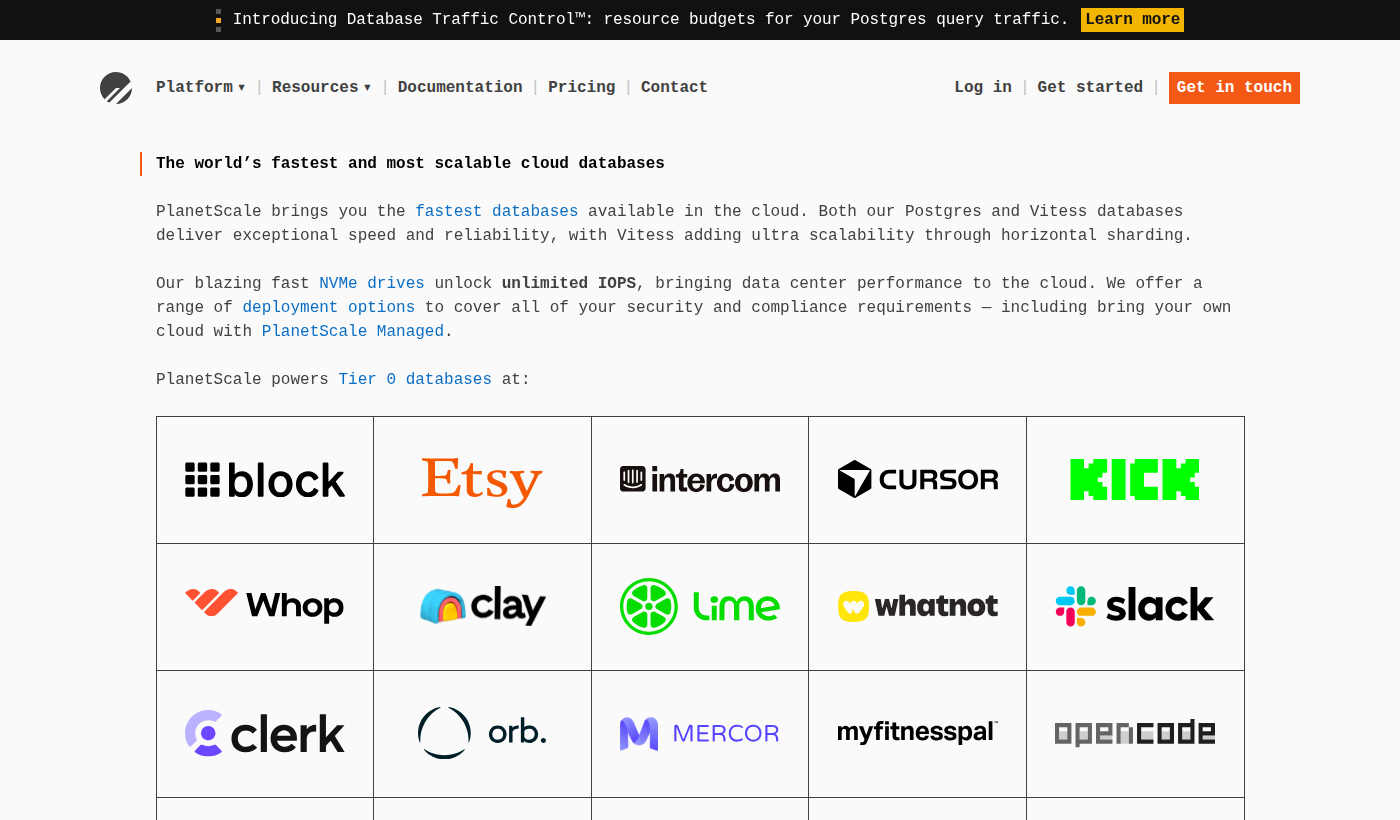
PlanetScale's official website describes the platform as a serverless MySQL-compatible database built for developers who demand both performance and operational safety at scale. At its core, PlanetScale is a database-as-a-service (DBaaS) platform that removes the traditional pain points of database operations — including schema migrations, scaling bottlenecks, and downtime risks.Founded in 2018 and headquartered in San Francisco, PlanetScale was created by the team behind Vitess, an open-source database clustering system originally developed at Google. That heritage gives PlanetScale a uniquely battle-tested foundation, having been proven across some of the internet's most demanding workloads before it ever became a commercial product.
What sets PlanetScale apart in the crowded DevOps & Infrastructure landscape is its branching model for databases. Just as developers use Git branches to write and test code before merging to production, PlanetScale allows teams to create database branches, apply schema changes safely, open "deploy requests" (similar to pull requests), and merge changes without locking tables or causing downtime.
Primary use cases include:
- High-growth SaaS applications needing horizontal scale
- Teams with frequent schema change requirements
- Organizations looking to eliminate database-related deployment bottlenecks
- Enterprises migrating away from self-managed MySQL infrastructure
---
Key Features of PlanetScale
1. Database Branching (Non-Blocking Schema Changes)
PlanetScale's most celebrated feature is its branching workflow for database schemas. Instead of running raw `ALTER TABLE` commands against production — which can lock tables and cause downtime — developers create a branch of their database, apply schema changes to that branch, and then open a deploy request. PlanetScale runs the migration using its proprietary online DDL tooling, ensuring schema changes happen without table locks or production interruption.
This is a game-changer for DevOps & Infrastructure teams where deployments used to require maintenance windows. Now, schema migrations happen continuously and safely, just like code deployments.
2. Vitess-Powered Horizontal Scaling
Under the hood, PlanetScale runs on Vitess, the open-source sharding middleware originally built at Google. This means PlanetScale can scale horizontally across multiple database shards without requiring application-level changes. As your data grows, the platform handles the complexity of routing queries across shards transparently.
For teams experiencing rapid growth, this removes the need to architect complex sharding solutions manually — a notoriously difficult and error-prone DevOps & Infrastructure challenge.
3. Query Insights & Performance Analytics
PlanetScale includes a built-in Query Insights dashboard that surfaces slow queries, problematic execution plans, and opportunities for index optimization. Developers can see exactly which queries are consuming the most resources, enabling proactive performance tuning without needing external APM tools.
This feature is particularly valuable for teams who want database observability baked into their infrastructure platform rather than bolted on afterward.
4. Deploy Requests (Pull Requests for Databases)
Mirroring the GitHub pull request workflow, Deploy Requests allow team members to review proposed schema changes before they go to production. Team leads can inspect the migration, check for potential issues, and approve or reject changes — bringing proper code review culture to database operations.
This collaborative feature reduces the risk of destructive migrations making it to production and helps junior developers learn safe database practices in a structured environment.
5. Connection Pooling at the Edge
PlanetScale automatically handles connection pooling between your application and the database, preventing connection exhaustion — a common failure mode for serverless applications that can spawn thousands of short-lived connections simultaneously. This makes PlanetScale especially well-suited for Next.js applications, serverless functions, and edge computing environments.
6. Global Replicas & Read Distribution
For applications with geographically distributed users, PlanetScale supports global read replicas that reduce latency by serving reads from a region closer to the user. This is a critical DevOps & Infrastructure capability for globally deployed applications where database read latency can significantly impact user experience.
7. Point-in-Time Restore & Automatic Backups
PlanetScale performs automatic daily backups across all plans and supports point-in-time restore on higher tiers. For compliance-sensitive organizations and teams that operate production systems with strict recovery time objectives (RTOs), this built-in data protection capability removes the operational overhead of managing backup schedules manually.
---
PlanetScale Pricing & Plans
Since detailed pricing information is not included in the research brief provided, specific tier costs and exact plan structures may have changed. PlanetScale has historically offered a tiered pricing model including a free Hobby tier, a Scaler plan for growing teams, and enterprise-level options — but current and accurate pricing should be verified directly on their website.
What is known about PlanetScale's pricing philosophy:
- Plans are structured around row reads, row writes, and storage rather than compute units, reflecting the serverless nature of the platform
- Higher tiers unlock features like point-in-time restore, additional database branches, single sign-on (SSO), and enhanced SLAs
- Enterprise plans typically include dedicated support, custom contracts, and advanced compliance features
> ⚠️ Pricing note: PlanetScale has updated its pricing model in the past, including adjustments to free tier limits. Always View PlanetScale pricing directly before making a purchasing decision.
For most small-to-medium development teams, the entry-level paid plan typically offers the best balance of features and cost — but confirm the current tiers on PlanetScale's website for the most accurate information.
---
Pros & Cons
PlanetScale Pros:✅ Non-blocking schema changes eliminate the risk of production downtime during migrations — a standout feature in the DevOps & Infrastructure space
✅ Vitess-powered horizontal scaling provides enterprise-grade scalability without manual sharding complexity
✅ Git-like branching workflow brings familiar developer workflows to database management, reducing the cognitive load of schema operations
✅ Built-in connection pooling solves serverless connection exhaustion problems out of the box
✅ Query Insights dashboard provides actionable database performance observability without third-party tools
✅ MySQL compatibility means minimal code changes are required for teams migrating from existing MySQL setups
PlanetScale Cons:❌ No foreign key constraint support — because of how Vitess handles sharding, PlanetScale does not support foreign key constraints at the database level, which is a significant architectural shift for some teams
❌ Pricing can escalate quickly at scale, particularly for read-heavy workloads, since billing is tied to row reads
❌ Vendor lock-in risk — while based on MySQL, some PlanetScale-specific workflows (branching, deploy requests) create operational dependencies on the platform
❌ Limited information available on advanced enterprise compliance certifications beyond what's published on their site
---
PlanetScale vs. Alternatives
PlanetScale vs. AWS RDS / Aurora
AWS RDS and Aurora are the default choices for many DevOps & Infrastructure teams already embedded in the AWS ecosystem. While Aurora offers impressive read scaling and RDS provides broad engine support, neither offers PlanetScale's branching-based schema change workflow. Teams on RDS still face table-locking migrations and manual schema management. PlanetScale wins on developer experience; AWS wins on ecosystem breadth and engine diversity.
PlanetScale vs. Supabase
Supabase is a popular open-source Firebase alternative built on PostgreSQL. While Supabase offers a broader feature set (including authentication, storage, and real-time subscriptions), it uses PostgreSQL rather than MySQL — making PlanetScale a more natural fit for teams with existing MySQL codebases. PlanetScale's schema branching also has no direct equivalent in Supabase's current feature set.
PlanetScale vs. Neon
Neon is a serverless PostgreSQL platform with its own branching feature, making it arguably the closest conceptual competitor to PlanetScale. Neon targets PostgreSQL users in the same way PlanetScale targets MySQL users. The choice between them often comes down to your existing database engine preference. Both represent the next generation of DevOps & Infrastructure database platforms built around developer-centric workflows.
---
Who Should Use PlanetScale?
Ideal for:- High-growth startups and SaaS teams that deploy frequently and can't afford downtime during database migrations
- Serverless and edge application developers using frameworks like Next.js, Remix, or [Vercel](https://vercel.com) who need robust connection pooling and scalable reads
- Teams migrating from self-managed MySQL who want to preserve their existing query logic while offloading operational overhead
- Engineering teams that value developer experience and want to bring collaborative review culture (pull requests, branching) to database operations
- Organizations scaling past what single-node MySQL can handle who need horizontal scaling without a full re-architecture
PlanetScale is less ideal for teams with heavy reliance on foreign key constraints, organizations requiring PostgreSQL, or those with highly cost-sensitive workloads at very large read volumes.
Visit PlanetScale's website to explore use case documentation and confirm whether the platform fits your specific infrastructure requirements.---
Getting Started with PlanetScale
Getting up and running with PlanetScale is designed to be straightforward:
- Sign up — Create an account at PlanetScale. A free tier has historically been available to let you explore the platform without a credit card.
- Create your first database — The dashboard guides you through creating a new database and selecting a region for your primary instance.
- Install the PlanetScale CLI — The `pscale` CLI tool allows you to manage branches, open deploy requests, and connect your local environment directly from your terminal.
- Create a development branch — Branch off your production database, apply schema changes, and test locally without touching production data.
- Open a Deploy Request — Once satisfied, open a deploy request and merge your schema changes to production — no downtime, no table locks.
- Connect your application — PlanetScale provides connection strings compatible with standard MySQL drivers, making integration with ORMs like Prisma, Drizzle, and Hibernate seamless.
---
Final Verdict
PlanetScale is one of the most genuinely innovative platforms in the DevOps & Infrastructure space today. By solving the notoriously painful problem of production database schema migrations — and doing so through an elegant, developer-friendly branching model — it earns a strong recommendation for any MySQL-centric team that ships frequently and values operational safety.
The Vitess foundation gives it a credibility and scale story that few competitors can match, and the developer experience throughout the platform reflects genuine product thinking.
That said, PlanetScale isn't for everyone. The lack of foreign key constraint support is a real architectural consideration, and teams deeply invested in PostgreSQL ecosystems will find Neon or Supabase a more natural fit. Pricing should also be evaluated carefully at scale.
For teams that fit its target profile — high-velocity MySQL shops tired of dangerous migrations and scaling headaches — PlanetScale is arguably the best solution available in 2026. Check out PlanetScale to see if it's the right database platform for your stack.
---
Frequently Asked Questions
Q: How much does PlanetScale cost?A: PlanetScale pricing is structured around serverless usage metrics (row reads, writes, and storage) with multiple tiers. Specific current pricing should be confirmed directly on PlanetScale's website, as plans and limits are updated periodically.
Q: What makes PlanetScale different from alternatives like AWS RDS or Supabase?A: PlanetScale's primary differentiator is its database branching and deploy request workflow, which allows teams to make schema changes without table locks or production downtime. This Git-inspired workflow has no direct equivalent in AWS RDS or most competing platforms. Additionally, its Vitess foundation provides proven horizontal scalability at a level most DBaaS platforms can't match.
Q: Does PlanetScale support foreign keys?A: No — PlanetScale does not support foreign key constraints at the database level due to how Vitess handles query routing across shards. Teams that rely heavily on foreign key enforcement at the database layer will need to handle referential integrity at the application level instead, which is a meaningful architectural consideration before migrating.
Q: Is PlanetScale suitable for serverless and edge applications?A: Yes — PlanetScale is particularly well-suited for serverless environments. Its built-in connection pooling prevents the connection exhaustion problems that plague serverless functions when connecting to traditional databases. It integrates well with [Vercel](https://vercel.com), [Netlify](https://netlify.com), and edge runtimes.
Q: Can I migrate an existing MySQL database to PlanetScale?A: Yes. PlanetScale is MySQL-compatible, meaning most existing MySQL applications can connect with minimal code changes. The primary migration consideration is removing any foreign key constraints from your schema before importing. PlanetScale provides detailed migration documentation to guide teams through the process.